Defining “Premium“ in the Cargo Lift Industry:
more than just a price tag
2025 04 15
In the heavy-duty lifting sector, the word “premium“ could often be misunderstood. Many view it as an aesthetic choice or “nice to have“ unnecessary expense. However, for distributors, installers, and facility managers, premium engineering is a strategic response to the persistent reliability issues that have plagued the market for years.

When cargo lifts fail to meet expectations, the consequences include operational downtime, safety risks, and escalating maintenance costs. Our HS Model is designed to shift the focus from the initial purchase price to the asset’s long-term value and reliability.
Intelligence through remote connectivity
One of the most significant frustrations for maintenance is the requirement for physical site visits to resolve minor technical faults or resets. A truly premium system prioritises intelligence to safeguard the installer’s time.
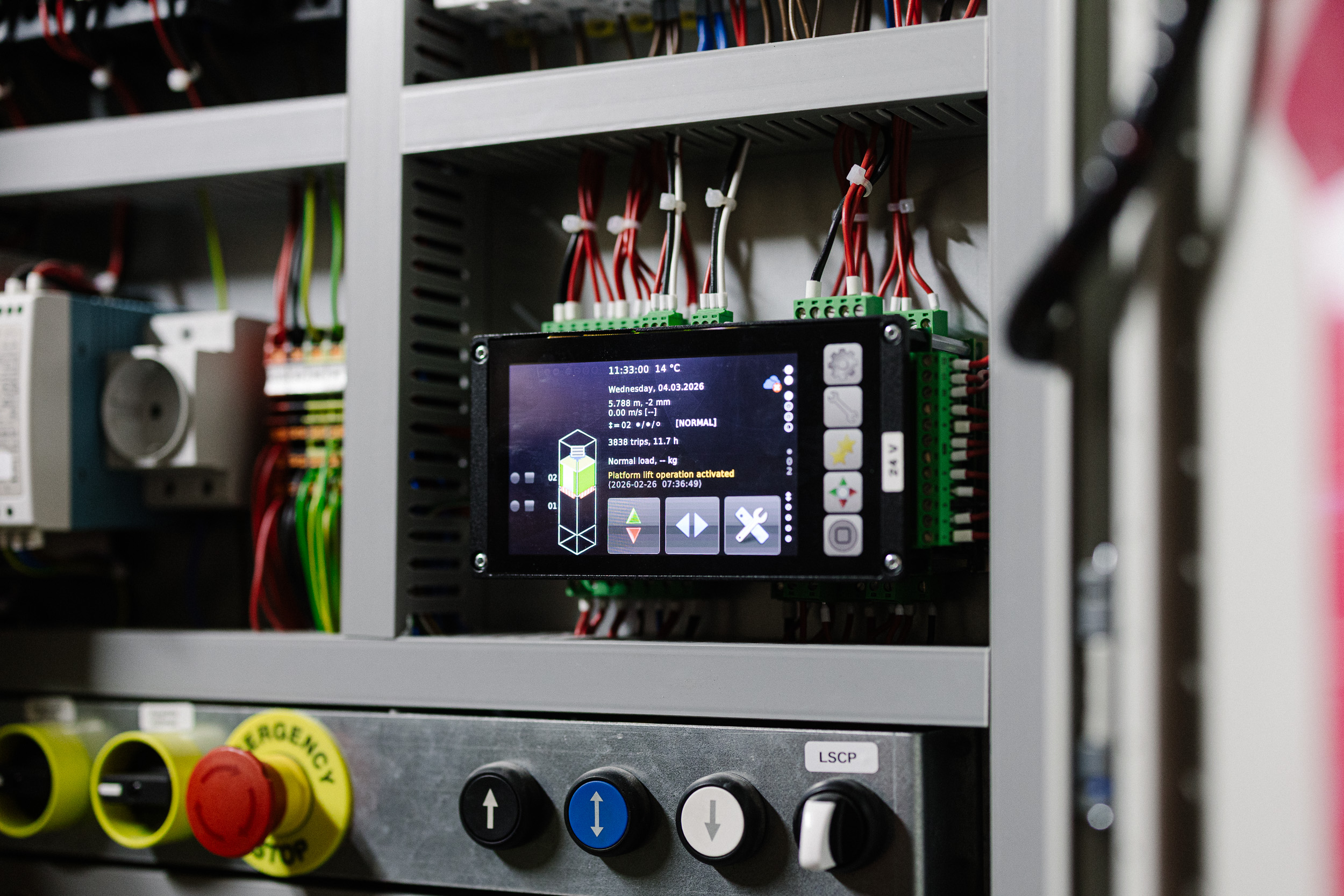
- Smart controller: the HS model is equipped with a smart controller capable of real-time remote monitoring and diagnostics. Evaldas Radzevičius, our Mechanical Design Engineer, notes that while not entirely novel, off-site monitoring and IoT connectivity in cargo lifts help the team determine the cause of any issues that may arise in real-world scenarios. This helps solve problems much more quickly and in a more evidence-based way.
- Reduced maintenance: By enabling remote troubleshooting, the need for on-site maintenance is significantly reduced, because you can foresee upcoming errors.
Precision and levelling
In modern logistics and retail environments, precision is a requirement for safety and efficiency. Standard hydraulic lifts often struggle with inconsistent stop levels, which can damage both the cargo and the lift itself during loading.
- Linear encoder: the HS Model utilises a linear encoder to precisely monitor the lift’s position and speed.
- Automatic re-levelling: the system keeps the platform level with the floor, regardless of whether the lift is fully loaded or empty.
- Electronic adjustments: stop levels can be adjusted electronically without physical modifications, enabling flexible changes tailored to each project.
Uncompromising Structural Integrity and Robustness
In an industrial or logistics setting, a cargo lift is a workhorse that must withstand the rigours of high-frequency usage and heavy workloads. True “premium” quality is found in the machine’s physical strength and the engineering philosophy behind it.
- The “Sleeping Well” coefficients: Mechanical Design Engineer Evaldas explains that safety is primarily achieved by considering potential misuse cases and ensuring adequate safety factors. He shares that his mentor used to call these the ‘sleeping well coefficients’.
- “Elegant” engineering: according to Evaldas, the biggest challenge is finding solutions that keep costs and production time reasonable while maintaining safety and reliability. “It is easy to design a structure that can cope with the loads,“ he says. “Designing one that can do that while remaining competitive in the market of today is much harder.“
- Robust construction: cabin panels are designed to withstand real-world conditions and ensure longevity.
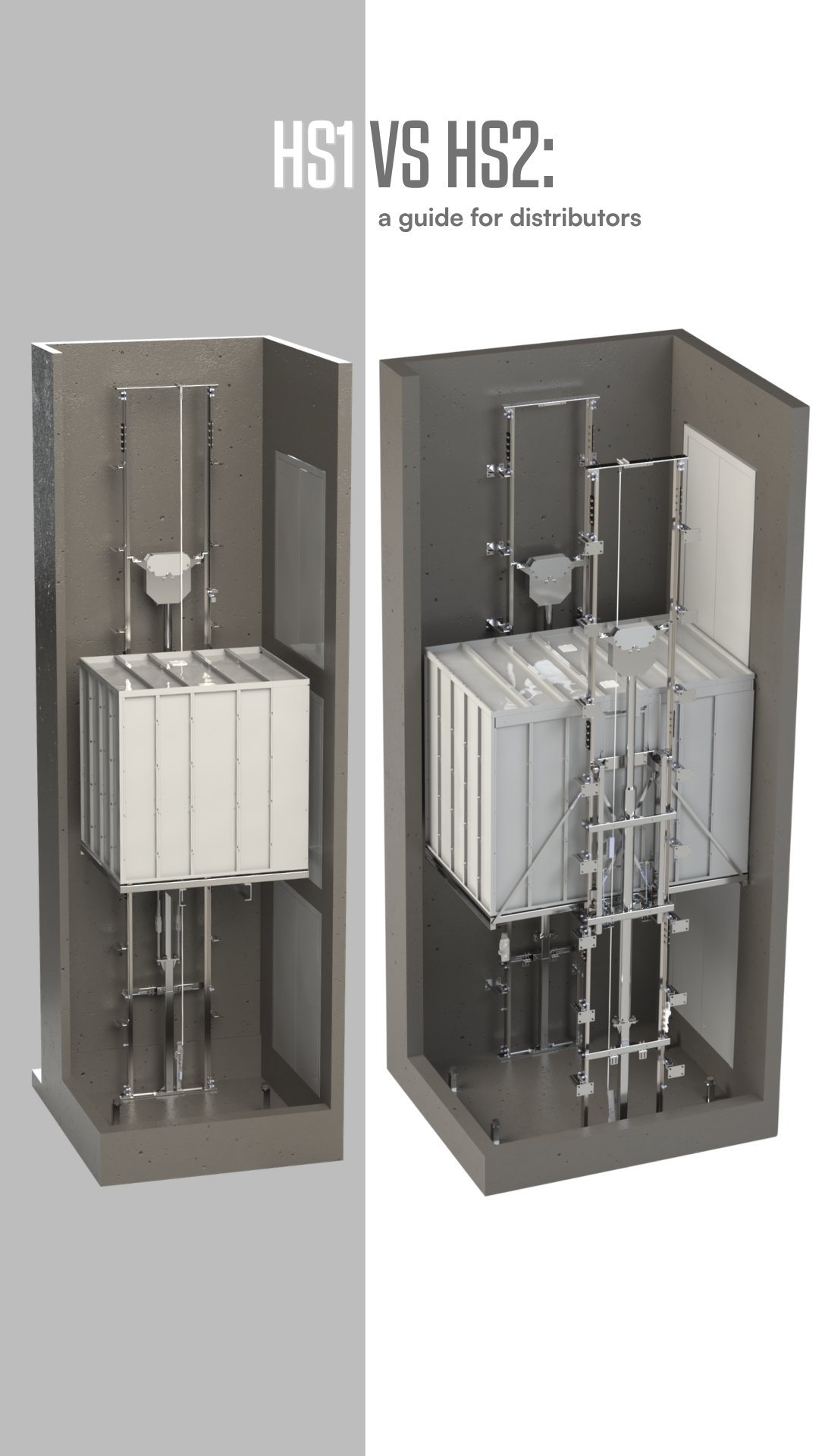
- High load capacity: the HS2 model is the heavy-duty powerhouse of the line, supporting load capacities of up to 3 tonnes with platform sizes up to 3m x 4m.
- Linear encoder: the HS Model utilises a linear encoder to precisely monitor the lift’s position and speed.
- Automatic re-levelling: the system keeps the platform level with the floor, regardless of whether the lift is fully loaded or empty.
- Electronic adjustments: stop levels can be adjusted electronically without physical modifications, enabling flexible changes tailored to each project.
Engineering for durability and smooth performance
The heart of a lift – the hydraulic system – is where the difference between standard and premium becomes most apparent. Traditional gear pumps can be loud and prone to vibration, which can accelerate component wear.
- Efficient screw pump: the premium option includes an optional screw pump that is more energy-efficient and reduces fluid turbulence for smoother operation.
- Soft start and stop: the feature provides gentle control to ensure smooth movement without sudden jolts, enhancing both user and cargo safety.
- Stable operation: we use precision-machined guides and heavy-duty load-bearing rollers to achieve stable, quiet operation, even under maximum load.
Overcoming spatial constraints
A premium product should solve architectural problems, not create them. Many existing structures cannot accommodate the deep pits or high headroom required by conventional cargo lifts.
- Minimal pit and headroom: with a minimal pit requirement of only 400 mm and a headroom of just 2400 mm, the HS Model is exceptionally well-suited for integration into any existing structures.
- Flexible configurations: the wide range of available options enables high space efficiency and integration into buildings of any type.
The bottom line: Total Cost of Ownership
A cargo lift is a long-term investment. While a lower-priced alternative may seem attractive initially, the total cost of ownership (TCO) often tells a different story.
Frequent repairs, higher energy consumption, and shorter lifespans quickly erode any initial savings. “Premium“ for us means building a product that protects your reputation as an installer and ensures the continuity of your client’s operations. We believe that the most expensive lift is the one that is constantly out of service.